THE HORN OF AFRICA
Ethiopia and Eritrea have cut diplomatic ties and accused each other of starting a war. The larger commercial exposure sits further south, on the corridor that carries almost all of Ethiopia’s trade to the sea.
BY BRANDON KANELL · INFORMATION CUTOFF: 20 OCTOBER 2026
Source: Daniel Miksha (Unsplash)
01 Key Takeaways
- Fighting between Ethiopian federal forces and Tigrayan armed groups is likely to continue, with the potential for further escalation. Full-scale interstate war between Ethiopia and Eritrea is unlikely through the end of 2026.
- Regional rivalries and competing security interests could deepen the conflict through diplomatic or military support for opposing parties. Direct military intervention by neighboring states is less likely.
- The conflict is unlikely to directly disrupt shipping through the Bab al-Mandab Strait, where the principal security threat continues to come from the Houthis.
- The Addis Ababa-Djibouti trade corridor is Ethiopia’s principal economic vulnerability. Rebel advances into Afar in late September increased the potential for disruption, although no interruption of trade has been reported. Further expansion toward transport infrastructure could affect imports, exports, and commercial confidence.
02 Context and Analysis
Ethiopia has been landlocked since Eritrea’s independence in 1993 and relies on Djibouti for most of its international trade. Djibouti’s maritime gateways handled 96.7% of Ethiopia’s external freight in the 2025/26 fiscal year, according to Ethiopia’s transport ministry. The A1 highway and the Addis Ababa-Djibouti railway are the main inland links to those ports. This dependence has made alternative maritime access a strategic priority, with particular interest in Eritrea’s port of Assab, which Addis Ababa considers important to its long-term economic and security interests.
Eritrea views Ethiopia’s renewed maritime ambitions as a potential threat to its sovereignty, amid concerns that Addis Ababa could seek access to Assab by force. Tensions have coincided with renewed fighting in northern Ethiopia and the formation in September of the Ethiopian Peoples’ Forces Alliance for Survival, a seven-group coalition that includes Tigrayan forces, the Amhara Fano movement, and the Oromo Liberation Army (OLA). The alliance indicates broader opposition to Prime Minister Abiy Ahmed’s government, although the extent of operational coordination is unclear. Suspected drone strikes on military sites in Addis Ababa on the night of 30 September, which a rebel-linked source attributed to the alliance, suggest the conflict is not confined to the north. Recent developments include the following:
- In late September, the Tigray People’s Liberation Front (TPLF) and allied groups launched an offensive in northern Ethiopia, reportedly with Eritrean backing, which Asmara denies. Ethiopian federal forces retook Mekelle, Tigray’s capital, in early October, amid the most intense fighting since the Tigray war ended in 2022.
- On 1 October, Ethiopia expelled ten Eritrean diplomats, prompting Eritrea to sever diplomatic ties. Regional opposition also intensified when Egypt, Eritrea, Somalia, and Sudan issued the El Alamein Declaration on 4 October, which holds that control of the Red Sea should rest with coastal states. A day later, Prime Minister Abiy reiterated Ethiopia’s demand for maritime access.
- Ethiopian drone strikes reportedly targeted Eritrean forces inside Tigray. Ethiopia invoked its right to self-defense in a letter to the UN Security Council, while Eritrea denied the incursion allegations and accused Ethiopia of waging a war of aggression.
- On 12 October, federal forces reached Zalambessa on the Eritrean border as Eritrean troops reportedly withdrew into Eritrea. By 17 October, federal forces had reportedly pulled back from Zalambessa and Rama toward central Tigray, while Eritrean troops reportedly remained in parts of the border area.
- Federal forces entered Aksum on 15 October. A day later, the federal government announced a six-month interim administration for Tigray, signaling an effort to consolidate control despite continued instability.
- Fighting has continued. Tigrayan forces are attacking federal supply lines in central Tigray, and alliance members in Oromia and Benishangul-Gumuz carried out their first notable attacks on federal forces. The United States and Russia have both offered to mediate between Ethiopia and Eritrea.
Federal forces reversed the rebel advances into Afar on 1 October, retaking Abala and Erebti, which sit on a secondary road linking northern Ethiopia to the A1 highway near Semera (Figure 1). The episode showed how exposed those connecting routes are. Further rebel advances, attacks on transport infrastructure, or military restrictions could disrupt trade through Djibouti.
The border is where the risk is most visible. The corridor is where it would be most expensive.
Regional tensions could further complicate the conflict. Egypt’s longstanding dispute with Ethiopia over the Grand Ethiopian Renaissance Dam (GERD), Somalia’s concerns over Ethiopian maritime ambitions, and Eritrea’s opposition to Addis Ababa’s pursuit of Assab have contributed to closer diplomatic coordination. The El Alamein Declaration reinforced these shared positions, although the prospect of coordinated military intervention is uncertain. These divisions could increase diplomatic pressure on Ethiopia and create opportunities for external support to opposing parties.
03 Commercial Implications
Renewed advances into Afar or attacks on infrastructure connected to the corridor could increase transportation costs, delay shipments, and disrupt fuel and essential imports. The corridor’s weight in Ethiopian trade makes any sustained disruption a significant economic risk.
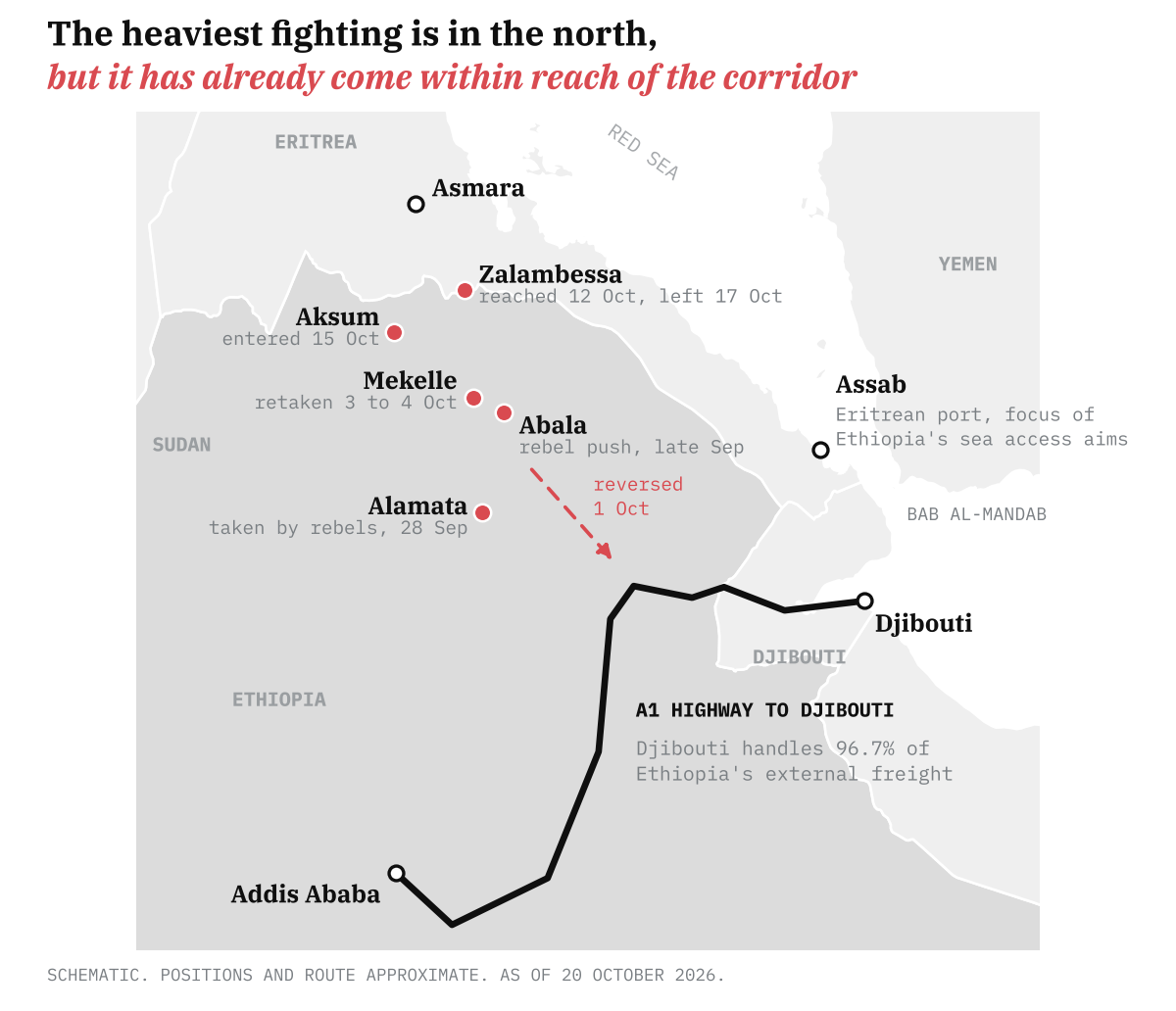
Figure 1. Key locations in the escalation and Ethiopia’s main trade route. Source: Brasidas, based on ACLED, Critical Threats and Al Jazeera reporting.
For shippers and logistics operators, the main risks include road closures, additional security requirements, and delays in moving goods between Djibouti and Ethiopian markets. Insurers could reassess political violence and cargo exposures if attacks extend toward major transport infrastructure. Investors and lenders could face project delays, higher operating costs, and increased repayment risk if sustained disruption affects trade flows and foreign exchange availability. Aviation is also exposed: on 16 October the TPLF threatened to target Ethiopian Airlines aircraft it suspects of carrying troops or military equipment.
The principal indicators of worsening commercial risk would be renewed rebel advances toward Semera, attacks on the A1 highway or associated transport infrastructure, restrictions on commercial vehicle movements, and confirmed interruptions to freight traffic. A direct Ethiopian-Eritrean military confrontation, particularly toward Assab, would represent a further escalation and could increase uncertainty over regional maritime access and investment conditions.
04 Forward Look Through 2026
The table below assesses potential developments through December 2026. Likelihood terms are qualitative: very likely (over 80%), likely (60 to 80%), even chance (40 to 60%), unlikely (20 to 40%), and very unlikely (below 20%).

Renewed rebel advances toward major transport routes would raise the likelihood of trade disruption, while sustained cross-border fighting would raise the likelihood of full-scale interstate war.
05 Most Dangerous Scenario (Unlikely)
In the most dangerous scenario, continued fighting in northern Ethiopia develops into a sustained interstate war between Ethiopia and Eritrea, potentially drawing in neighboring countries. Ethiopia could attempt to secure access to the port of Assab by force. Eritrea may respond with direct military action or by increasing support for Ethiopian armed opposition groups. Such a confrontation would threaten regional trade routes, increase instability around the Red Sea, and place additional pressure on Ethiopia’s already vulnerable access to international markets.
A wider regional war is unlikely. The nearer commercial risk is renewed fighting toward the corridor, and that is where monitoring should concentrate.