PART FOUR OF TEN: THE WEAPONIZATION OF AI
In the first week of September, two things happened three days apart. In Geneva, the United Nations talks on autonomous weapons ended without a mandate to negotiate anything. In Kyiv, a defense ministry published the results of a test and recommended six autonomous strike systems for purchase.

A commercial airframe in a field. The part that changed is not the airframe. Source: Altin Çibukçiu (Unsplash)
The test is worth describing precisely, because the detail is the argument. On 8 September Ukraine’s Ministry of Defence and the Brave1 cluster published the results of what it called the first large-scale test of automatic guidance technology run under a single scenario and clear criteria. Seven companies took part.
01 What the Drones Had to Do
Each system had to fly two kilometers, detect a moving lightly armored vehicle from at least 500 meters, lock onto it and strike it in fully autonomous mode with the pilot’s hands off the controls. Multirotor airframes above ten inches, payload at least two kilograms, three attempts each, two hits out of three to pass.
Six of the seven manufacturers passed. Their systems were recommended for procurement.
The same release notes that successful strikes using AI guidance have grown tenfold since the start of 2026, and that Ukrainian units already field more than seventy AI and computer vision systems for striking targets. It also contains one sentence that the rest of this article is really about: a human still makes the decision to carry out a strike.
02 This Is a Countermeasure, Not an Ambition
It would be easy to read autonomous terminal guidance as technological enthusiasm. It is the second answer to a problem that has no first answer left.
Russian electronic warfare is among the most capable in the world, and a radio-controlled drone is a radio before it is anything else. Ukrainian operators describe the effect in plain terms. A commander in the 12th Special Forces Brigade Azov, speaking to The War Zone, put the chance of a radio-controlled drone reaching its target at around 30 percent, against roughly 50 percent for a fiber-optic drone, which cannot be jammed because it trails a physical wire. Those are one commander’s figures for one unit rather than a general statistic. The direction they point in is not in dispute.
So there are two ways to defeat a jammer. Run a wire, or remove the link. The wire works and it has real costs: spool length caps the range, the drones are fragile, and the same commander put fiber-optic drones at under five percent of his unit’s fleet.
Removing the link avoids those physical constraints, but it does not remove cost. It moves the burden onto onboard computing, sensing and reliable target recognition. What changes is what happens after that. Once developed and validated, the software can be adapted across compatible platforms without the physical constraints of a tether, although each integration still has to be tested.
Autonomy here is not the goal. It is what is left when the radio stops working.
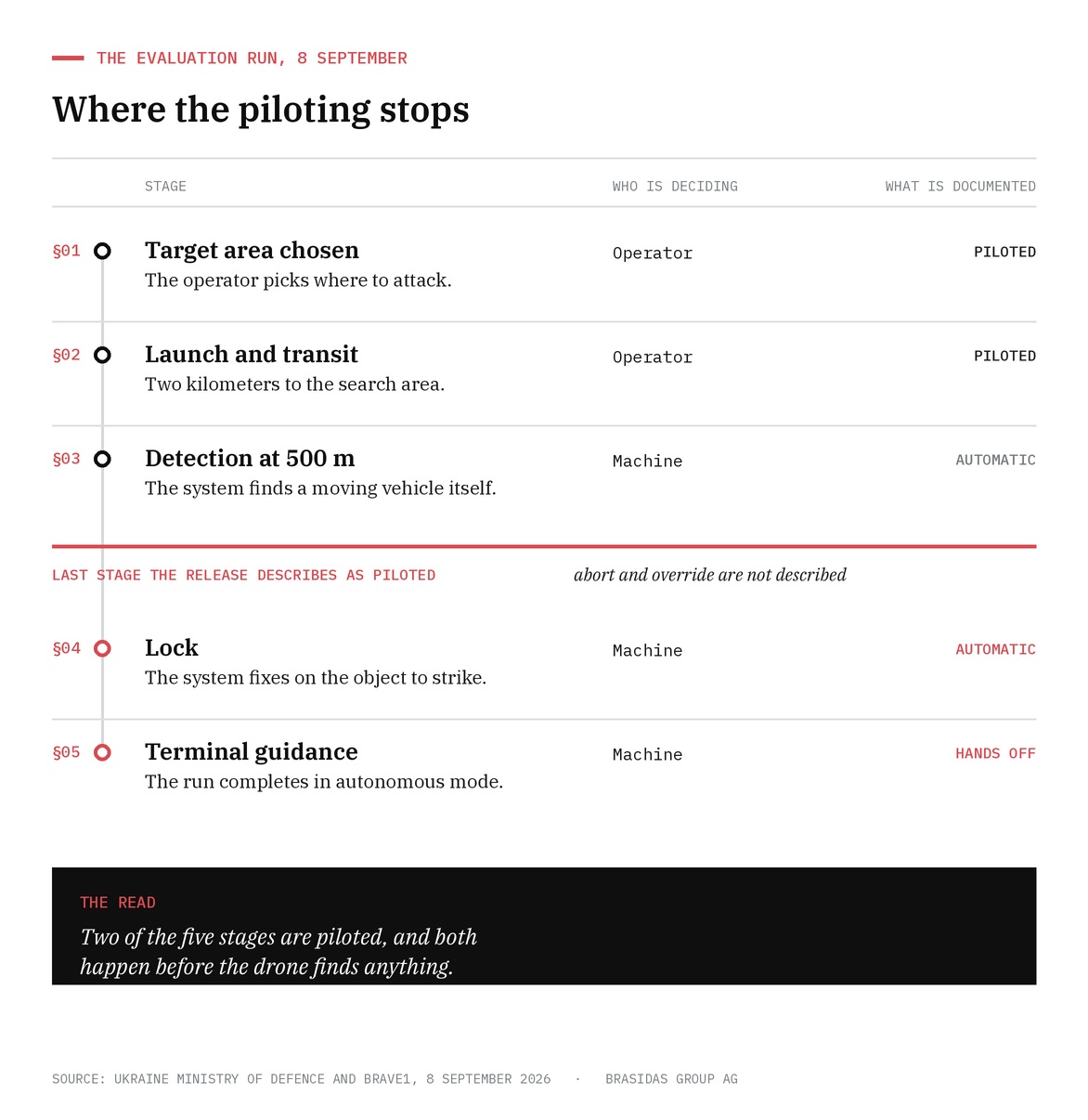
The five stages of the test on 8 September, and what the release describes at each one. Brasidas Group AG.
03 Where the Last Human Step Actually Sits
The Ministry’s formulation is that a human still makes the decision to carry out a strike, and on the published test conditions that is accurate. An operator chose the target area, launched the drone and committed to the attack.
It is also doing a great deal of work. The test required the system to detect a moving vehicle at 500 meters and lock onto it without help. Whatever the operator decided, they did not decide which pixels on which frame constituted the target.
Be precise here. What the release documents is hands off the controls through the terminal phase. It does not say whether an abort or override remained available, and that distinction is worth holding: demonstrated hands-off guidance is not the same as a demonstrated inability to call the strike off. The direction of travel is not in doubt either way, because a link you can use to abort is a link an adversary can jam.
This is why the vocabulary matters more than it appears to. Detection, selection and terminal guidance are three different things and they are routinely collapsed into one. The narrow description of what was tested is more useful than any of the shorthand: the human authorizes the engagement, and the machine identifies and tracks the object to be struck within the parameters it has been given.

The negotiating track has produced a report, not a mandate. Source: Anh Tuan To (Unsplash)
04 The Three Days in September
Now set the test beside the calendar.
On 25 August, the United Nations Secretary-General and the President of the International Committee of the Red Cross issued a joint appeal on autonomous weapons. Antonio Guterres said that the world is now dangerously close to crossing a moral red line, the autonomous targeting of humans by machines. The appeal asked for two prohibitions, on systems whose outcomes operators cannot predict and on anti-personnel systems designed to target people. It pointed to the Seventh Review Conference of the Convention on Certain Conventional Weapons, in Geneva this November, as the clearest path available.
The two institutions had first asked states to open negotiations on a legally binding instrument in 2023, and to conclude them by 2026.
The expert group met in Geneva that week, 128 states in the room, and adopted its report in the early hours of 5 September. Human Rights Watch’s account is that the text was significantly weakened on the way through: references to design and development removed, the scope narrowed to international humanitarian law, and ethical considerations, predictability, reliability, explainability and traceability dropped. By that count 76 states supported moving to negotiations, 70 of them parties to the Convention.
Reuters reported that the United States had proposed late changes and deletions and that its position had hardened over the preceding six months, preferring guidelines on the argument that international humanitarian law already governs the conduct of war, with Russia, India and Turkey supporting that position.
Since then the picture has moved on paper. According to Stop Killer Robots, the First Committee of the General Assembly adopted a resolution in late October, tabled by Austria and 34 co-sponsors, calling on parties to the Convention to move to negotiations. The campaign reports 163 votes in favour, five against and nine abstentions. Ireland spoke beforehand for 52 states ready to agree an ambitious mandate in November, and the European Union said the same from the floor on 21 October. None of it is a mandate. It is a very large number of states saying they would like one.
And three days after the Geneva session closed, a defense ministry recommended six autonomous strike systems for purchase.
They asked for negotiations to conclude by 2026. Less than nine weeks remain, and they have not begun.
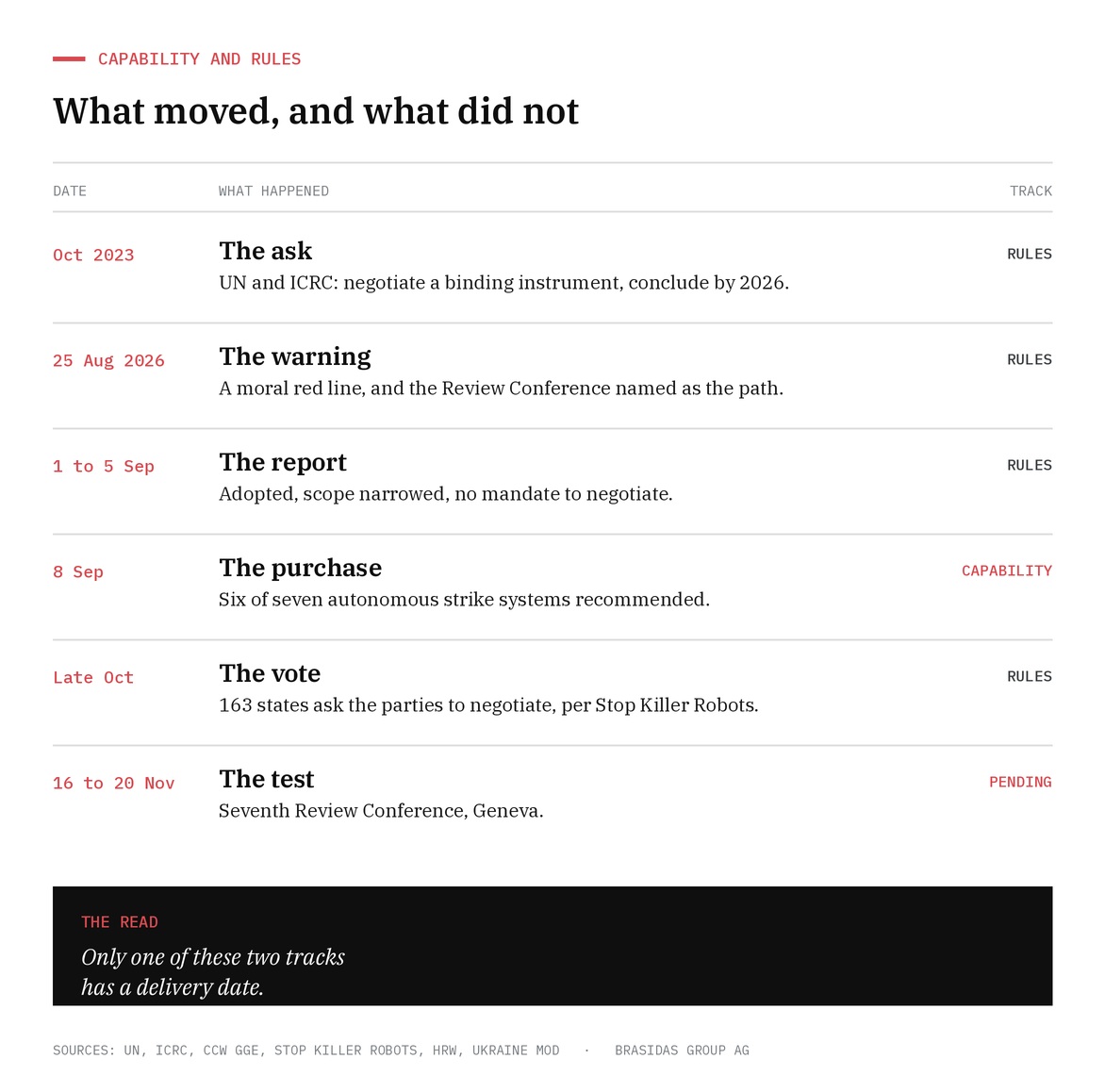
Three years of asking, and what actually happened in the last three months. Brasidas Group AG.
05 What This Means If You Build, Fund or Insure This
The first thing to be clear about is that no new treaty does not mean no law. For states party to Additional Protocol I, Article 36 already requires that in the study, development, acquisition or adoption of a new weapon or method of warfare, the state determine whether its employment would be prohibited in some or all circumstances. National frameworks impose their own requirements, and the rest of international humanitarian law applies regardless. The ICRC’s guidance is specific in a way that matters commercially: a purchasing state must conduct its own review rather than rely on the vendor’s assessment or another state’s. A procurement recommendation is not a legal weapons review, and the obligation attaches to the buyer.
For companies building autonomy, and for the funds backing them, the export control question has moved under the software. Nothing about an AI artifact is automatically controlled. Whether a model, its weights, its training data or the documentation around it is caught depends on content, function and jurisdiction, and on which regime applies, the stricter ITAR for defense articles or the EAR for dual-use items. The test is in the regulation itself: ITAR defines technical data by reference to information required for the design, development, production, operation or modification of a defense article, and treats software directly related to one the same way, while excluding what is public domain or commonly taught. A specialist review published in April reads that as meaning code can be controlled to the same degree as a physical platform where it is specially designed for one. For a board the practical point is that classification follows informational content rather than file type, and nobody can tell you where a given stack sits without looking at it.
That produces exposures most technology diligence is not built to find. Giving a foreign national on your own engineering team access to a repository can be a deemed export. Helping a foreign partner integrate a targeting system can be a defense service with no file changing hands. Open-source components are not automatically exempt, and a defense contract does not substitute for an export authorization.
The exposure is also moving beyond the airframe and into the data. On 25 September Ukraine’s Ministry of Defence announced that up to twelve British defense companies would be admitted to Avengers Labs, its platform for training models for unmanned systems on real battlefield data. The Ministry describes an annotated dataset of more than five million frames, drawn mostly from unmanned systems through the DELTA system and anonymized and delayed before use, with more than thirty Ukrainian companies already training on it and three resulting products in use. Participants do not receive the dataset and cannot download it. They train inside the perimeter. The arrangement is careful, and it raises a question with no settled answer: when a model is trained on another state’s battlefield intelligence, what has actually been transferred, the data, the capability it produces, or both.
For investors and insurers, the central question is no longer whether the technology works. It is whether the company can demonstrate that its development, transfer and deployment comply with the law that applies to it. Three questions belong before the term sheet. What in this stack is the controlled item, and has anyone obtained a jurisdiction determination rather than an opinion. Who has had access to the model weights and the training data, by nationality and by date. And if a binding instrument arrives in the next two years, which parts of this product would have to change, and would the records exist to show what it did and when.
06 Our Assessment
Three things follow.
First, the capability has moved from demonstration into structured evaluation. A state ran a single standardized scenario, applied a pass mark and moved six suppliers toward procurement. That is not certification and not proof of operational readiness, and should not be described as either. It is the step a technology takes on the way to becoming ordinary.
Second, the human in the loop is a real constraint and a shrinking one, and the two are not in tension. The operator’s decision is genuine. The window in which it can be revised is narrowing, because an open window is a vulnerability. Any control regime built on the assumption that a person can always intervene is being designed against the grain of the engineering.
Third, the gap between capability and rules is widening rather than closing, and November is the test of whether that continues. If the Review Conference opens negotiations, the companies in this market acquire a compliance horizon they can plan against. If it does not, the field will go on being governed by existing international humanitarian law, domestic rules, weapons reviews and export control. That is not an absence of regulation. It is a more fragmented one, and much harder to plan against.
We would watch one specific thing. Not whether autonomous systems are used, which is settled, but whether any state publishes the legal review that accompanied a procurement decision. States are under no obligation to publish them and most never have. Any that do appear will likely be redacted and may omit the parameters that matter most. Even so, the first will tell you more than a communique.
Next in this series: what the Seventh Review Conference in Geneva decides in November, and what it changes for anyone building, buying or funding autonomy.