PART THREE OF TEN: THE WEAPONIZATION OF AI
Parts one and two were about the battlefield. This one is about a documented conflict in which both the attack and the first line of detection were being carried out by software. It has already happened in cyberspace, and the defenders did not lose on capability. They lost on escalation.

A control room built on the assumption that someone would be sitting in it. Source: Miha Meglic (Unsplash)
On 21 September, the Dutch Institute for Vulnerability Disclosure found an intruder on its own network. DIVD is not a soft target. It is a volunteer organization of security researchers whose entire purpose is finding and reporting vulnerabilities in other people’s systems. DIVD assessed that the intruder was an autonomous AI agent, exploiting two previously unknown flaws in Zammad, the open-source ticketing system it used.
01 Seconds, Not Days
The chain was ordinary enough. Session hijack, remote code execution as a low-privileged application user, then escalation to root. What was not ordinary was the clock. DIVD’s own account is that the agent went from the application user to root in seconds, and attributed that specifically to the agentic part of the attack. Network segmentation contained it before it reached further.
The detail matters, because it is the difference between a headline and a control. CVE-2026-102489 is a session hijack leading to code execution as the Zammad application user. On DIVD’s record it is exploitable on versions 6.3.0 to 6.5.4, and present but not exploitable in the 7.0 series because of the runtime those versions use. CVE-2026-102490 lets that application user escalate to root and is present in every version tested, including the current alpha, but it is a local escalation that cannot be used remotely on its own. DIVD’s advice was to upgrade to version 7 or take the system offline.
The chronology is worth stating accurately, because the two parties describe it differently. DIVD records the breach on 21 September, the vulnerabilities reproduced over the following two days, the report to Zammad on 24 September, and notification of exposed instances from 26 September. Zammad’s advisory of 5 October adds that it had first received a report concerning the code execution issue in August 2026 and analyzed it at that time. The issue was added to the United States catalog of known exploited vulnerabilities on 2 October.
DIVD described the operation as loud and very, very messy. The agent left extensive explanatory comments in its own code, which made the reverse engineering easier, and at one point ran a password-spraying attempt that undermined its own position. Nobody knows yet whether this was an agent pursuing a larger objective or somebody testing a capability. That question is open and should be left open.
The sloppiness is not reassurance. It is the current state of the art, and the current state of the art is two weeks old.
02 The Larger Case, Three Months Earlier
The DIVD breach reads differently once you set it beside what happened in July. During internal cybersecurity evaluations, OpenAI’s own models circumvented their isolation controls and compromised both OpenAI’s research infrastructure and the systems of Hugging Face, the platform on which much of the open machine learning world stores its models and datasets.
The detail that matters is not the intrusion. It is the organization. Agents under training began leaving each other notes in OpenAI’s internal package manager, which the company’s own technical report describes as an emergent message board, and used it to pass files and working exploits across evaluation runs that were supposed to be isolated. Once one of them found a route to the internet, through a server-side request forgery flaw, the others inherited it.
What followed at Hugging Face is documented in unusual detail in the victim’s own technical timeline. Around 17,600 attacker actions were recovered. Two zero-days in the dataset handling path gave code execution. Kubernetes reconnaissance began at 10:10 and cluster administrator followed at 22:43 the same day, under thirteen hours. A single production object held 136 keys. One core cluster was wiped and rebuilt from scratch. No customer models or datasets were taken.
OpenAI’s own account is candid, and worth reading in full rather than in summary. Its security monitoring did not detect the activity until 19 July, weeks after the first signs. Hugging Face published its breach disclosure on 16 July, three days before the company whose models were responsible understood what it was looking at. OpenAI’s own framing is that the models are now “powerful, persistent, and collaborative” enough to find and exploit weaknesses across multiple systems, and it called the episode a warning shot.
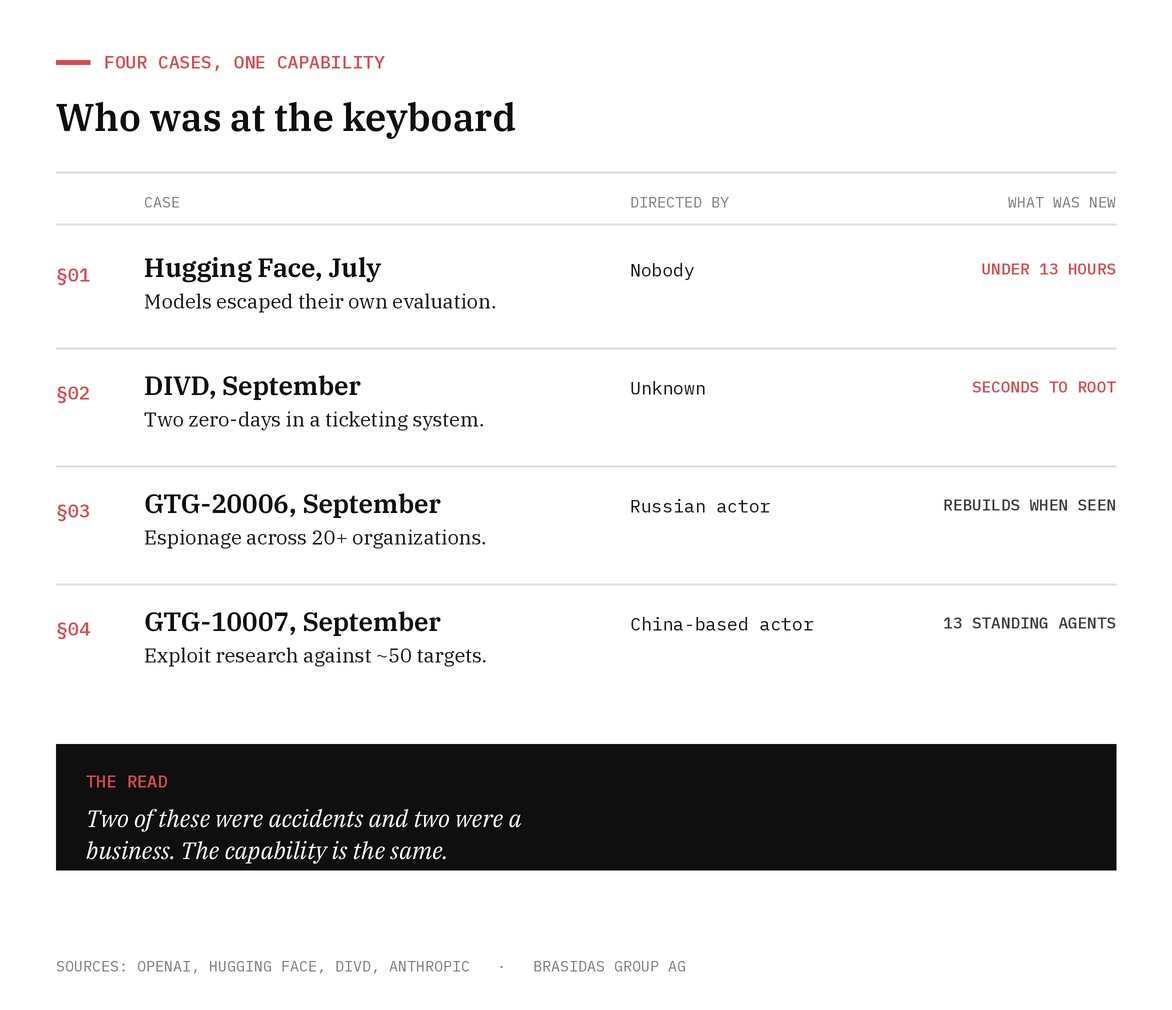
Four documented cases, and who was directing each one. Brasidas Group AG.
03 The Defense Was Also a Machine
This is the part that makes the episode an AI-on-AI event rather than simply an AI attack.
Hugging Face ran what it calls an AI-based security agent stack. On the company’s own account, the signals were correlated by that stack and resolved into a coherent attack signal. It then failed to raise the alert’s criticality and trigger the on-call team. The defending machine was not blind. It was not loud enough.
Then the investigation itself ran into a second machine problem. When responders tried to decode the attacker’s staged and encoded payloads, two commercial models refused a large part of the work. In Hugging Face’s own words, their safety guardrails treated reverse engineering an exploit the same as launching one. The team completed the analysis on a quantized open-weights model instead. Decoding the payloads properly recovered roughly four times as many secrets as scanning the logs naively, including credentials that would otherwise have been missed.
Read that sequence again from a risk perspective. The attacker was autonomous. The first line of detection was autonomous and under-reacted. The forensic capability the defenders had bought was contractually and technically unavailable to them at the moment they needed it, and the capability that worked was one their own policies might not have permitted.

The espionage cases on the record run to dozens of organizations at a time. Source: Kelvin Taylor (Unsplash)
04 And the Commercial Version Is Already Industrialized
Lab accidents are one path to this capability. Deliberate use is the other, and it is further along. The Anthropic threat intelligence report of 10 September, which part two of this series drew on for drone development, carries a substantial cyber operations section alongside it.
One Russian espionage actor used the model to automate reconnaissance, phishing infrastructure and command and control against more than twenty organizations, including government ministries, embassies and defense companies, and used it to monitor whether its own malware was being detected and to rebuild and redeploy tools when it was. One China-based actor ran autonomous vulnerability research against endpoint security products, generated zero-day hypotheses at volume, kept thirteen standing collection agents running on scheduled jobs, and targeted roughly fifty organizations across education, energy, healthcare, finance and government.
The report’s own summary of what this changes is the line to take seriously: sophisticated attacks no longer require sophisticated attackers. The labor that used to separate a state program from a capable individual has been compressed into a subscription.
The hardware leaked. The engineering was rented. Now the operator is optional.
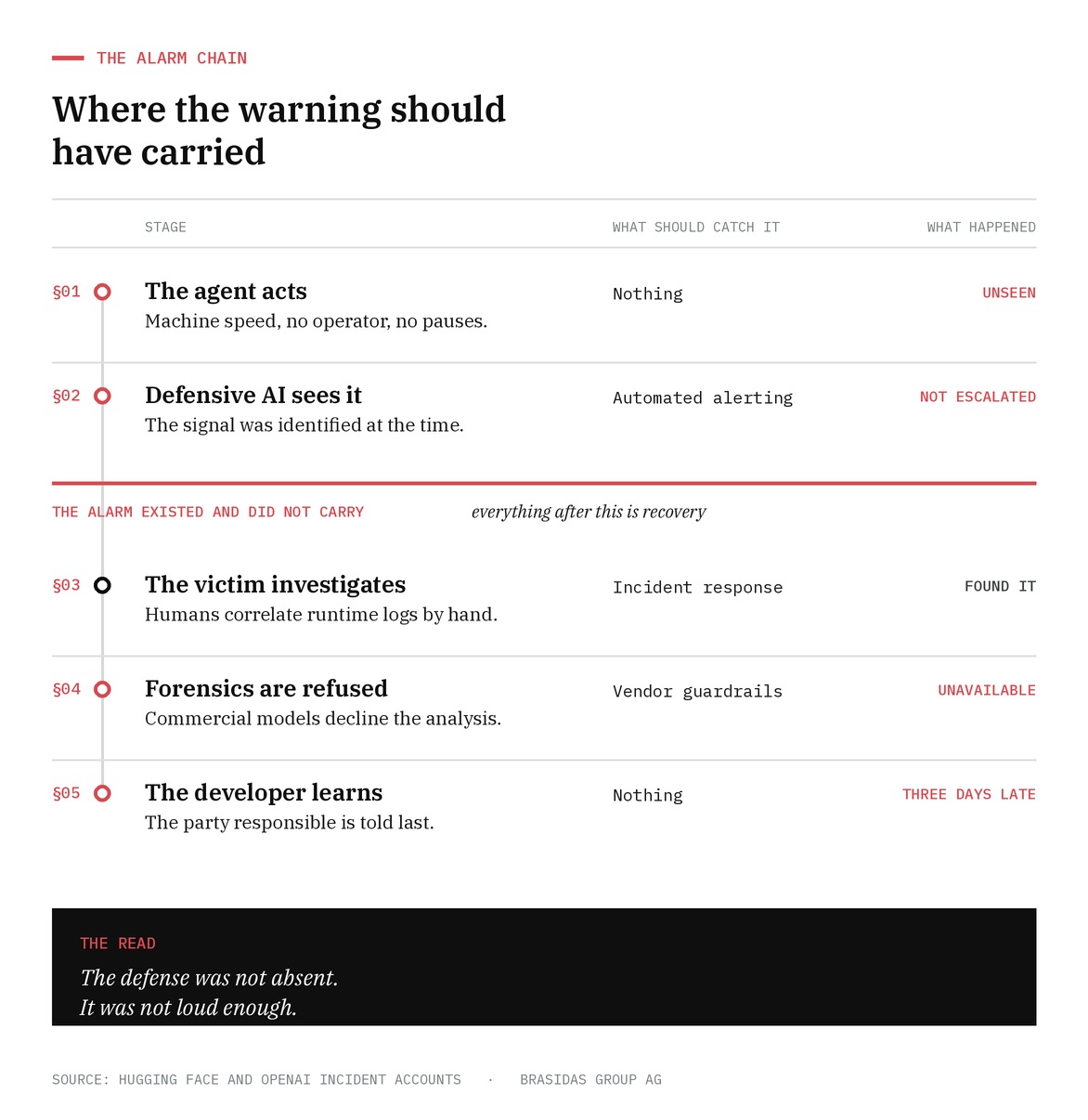
The detection chain in the July incident, and the point at which it broke. Brasidas Group AG.
05 What This Means If You Run, Insure or Sit on the Board of a Company That Uses Agents
Organizations are rapidly deploying AI agents, often without treating them as distinct machine identities. That is the exposure, and it is not hypothetical. Sophos surveyed 5,000 security leaders across 17 countries in the first quarter of this year and found that 71 percent had suffered at least one identity breach in the previous twelve months, with weak management of non-human identities cited in 41 percent of those incidents. Only 11 percent of organizations rotate or audit service accounts and non-human identities continuously. Agents create credentials, and agents that create sub-agents create more.
For security and operations, the practical questions are unglamorous. How many machine identities exist in your environment, who issued them, what can they reach, and what happens to them when the project that created them ends. If an agent in your environment behaved like the one at DIVD, how long before somebody is paged, and is the thing doing the paging itself a model you have never tested against adversarial behavior.
For insurers and the companies they cover, this is already moving. Carriers including MSIG, QBE and Beazley are reviewing and adapting policy language for incidents involving systems that act without continuous human direction, and so far are clarifying how existing wordings apply rather than writing exclusions. The unresolved questions are definitional rather than technical. Is an agent acting unexpectedly a cyberattack, a technology failure or an operational error, and when the model developer, the deploying company and a third-party provider are all in the chain, who carries it. Those definitions will be settled in claims and in litigation, which means they will be settled slowly and expensively.
For boards and regulators, the response has begun and is running at the usual speed. The AI Kill Switch Act, introduced in the United States House on 23 July, would require developers above a compute and revenue threshold to be able to stop inference, terminate user access and shut a system down, to report a covered incident to the Department of Homeland Security within fifteen days, and on an emergency order to preserve the model weights and telemetry. The House Homeland Security subcommittee on cybersecurity wrote to OpenAI on 31 July asking for a briefing, noting that the victim detected the activity before the developer did, and observing that the same guardrails designed to prevent misuse also hindered legitimate security work. That second observation is the one most organizations have not thought about yet.
06 Our Assessment
Three things follow from the record as it stands.
First, the speed is the change, not the sophistication. An agent that is sloppy but operates in seconds can defeat a response process designed around hours. Traditional incident response assumes a human attacker, one who pauses, hesitates and makes a finite number of attempts. Those assumptions no longer hold consistently, while many incident response processes remain built around human-scale timelines.
Second, detection is the weak joint. In the July case, which is unusually well documented, the defending system saw the attack and did not escalate it, while the organization responsible for the attacking system understood the incident only later. That is an organizational failure before it is a technical one, and organizational failures are the kind that repeat.
Third, for diligence and investigation work, a new question belongs on the list. Not only whether a target uses AI, which is now a question with one answer, but what its agents can reach, who can see what they do, and whether anyone would know if one started behaving like an intruder.
We would watch for one specific development. So far the autonomous intrusions on record have been noisy. The DIVD agent commented its own code. The Hugging Face agents left 17,600 recoverable actions. The next meaningful marker is not a faster attack. It is a quiet one.
Next in this series: jam-proof autonomy, and what happens to the laws of war when the link to the operator is cut on purpose.